


Aug 2026Read full article
Cost of Building a House in Cyprus, 2026
What it costs to build a house in Cyprus in 2026 — the rate per m², a full worked budget from plot to keys, and where the number really moves.
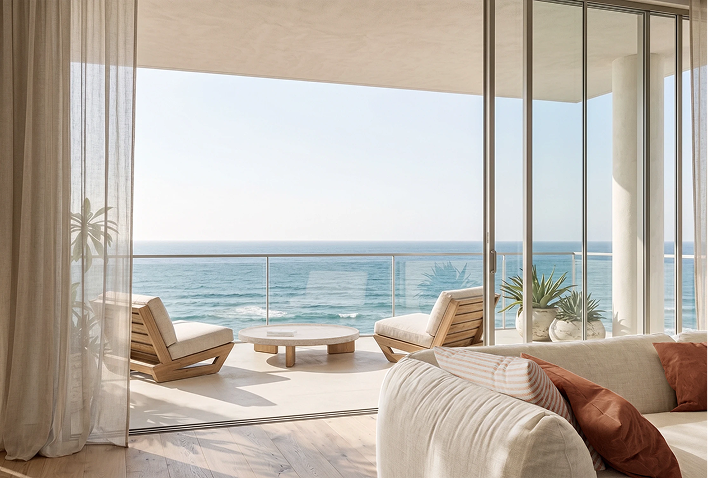
Premium villa pricing in Limassol does not behave as one market. It behaves as three, and they have moved in different directions this year: the top of the market has risen fastest, the middle has held, and entry-level premium has barely moved at all.
That matters more than the headline average, because the average sits in a band almost nobody actually transacts in. A seafront villa in Amathus and a new-build in Palodia are both "premium Limassol", and the gap between them is wider than the gap between Palodia and the mid-market.
Below is the band structure we use when advising clients, neighbourhood by neighbourhood, with what drives a plot from one band into the next — and the costs that sit outside the purchase price and catch foreign buyers most often.
A band is defined by what a buyer is actually paying for. In the top band that is position — seafront, or an unobstructed sea view that planning cannot take away. In the middle it is the building itself: plot size, build quality, and how recently it was finished. At entry level it is the address, with the building doing less of the work.
The practical consequence is that improving a building moves a property within its band, but rarely between bands. Position is the thing you cannot renovate your way into.
| Band | Typical areas | Price range | €/m² built | Plot size |
|---|---|---|---|---|
| Top — position-led | Amathus, Agios Tychonas seafront | — | — | — |
| Middle — building-led | Germasogeia, Palodia, Mouttagiaka | — | — | — |
| Entry premium | Ypsonas, Erimi, Pyrgos | — | — | — |
Position is the thing you cannot renovate your way into. Everything else in a villa can be changed later; the view cannot.
Band ranges describe a single market. The question buyers ask next is how that market sits against the rest of the island — and that answer changes month to month, which is why it is read live here rather than written into the page.
These are advertised prices — what a seller is asking, deduplicated across portals and weighted by floor area. They are not transaction prices, and the difference matters: what a property is listed at and what it changes hands for are rarely the same number. Where we cannot measure something directly we leave it out rather than estimate it, so no transacted figure appears here.
Reading live market data…
Buyers usually ask what a villa is worth. The more useful question is what would have to be true for it to be worth more, and the answers are surprisingly few.
A sea view that a future building can block is worth materially less than one that planning protects. A plot and zoning consultation on the land in front is the single highest-value hour of due diligence available.
Two identical plots can carry very different buildings. Coverage, height and setback allowances are what a developer is really buying, and they are public information before you make an offer.
Slope, rock and access all convert directly into cost, which is why a quantity survey against a real design beats a per-square-metre guess. A cheaper plot with a difficult approach frequently ends up the more expensive project.
A separate title deed, no encumbrances, and permits that match what is standing. Anything missing here is a discount at best and a stalled sale at worst.
Minutes matter more than kilometres in Limassol, and the relationship is not linear — the premium concentrates sharply in the first few minutes.
A poor Energy Performance Certificate is now priced in by buyers rather than ignored, and it sets the size of the renovation that follows.
Several things about the Cypriot market surprise buyers arriving from elsewhere in Europe, and all of them affect price.
Title deeds are the first. A property can be sold, occupied and mortgaged while its separate title deed is still being issued, which is legal and common — but it changes what you are buying and should change what you pay.
The second is that planning permission and building permission are separate applications with separate timelines. A plot marketed as "with planning" may be a long way from a building permit.
The third is that a great deal of what determines value is a matter of public record, which is why our work with homeowners starts with the plot rather than the building. Zoning, coverage, height and permitted use are checkable before you make an offer, and checking them is inexpensive relative to what they decide.
Most of what determines a villa's band is public, free and checkable before you make an offer. The work is knowing which register answers which question.
The building is the visible part and the plot is the durable part. Buyers reliably over-weight the first.
Asking prices in a thin segment reflect what sellers hope for. Transacted prices are the market, and they are not always the same number.
The report either buys you a negotiating position or tells you to walk. Both outcomes are worth more than its cost.
It is permanent only if the planning envelope in front of it says so. That is a question with a definite answer.
A €/m² figure only means something within a band. Across bands it flatters the wrong properties and misleads on every side.
In the middle band the two routes compete directly, and the comparison is usually made badly. A finished villa is priced on what it is; a plot is priced on what it could become, and the distance between those two numbers is the whole decision.
Building lets you buy position first and resolve the house afterwards, which in a market where position drives the bands is a real structural advantage. It costs time, and it costs the attention that running a project demands.
Buying finished removes the programme risk and the coordination, and you pay for both. In the same position, per square metre, finished stock trades above what the same house would cost to build — that gap is the price of certainty and of not waiting.
The comparison only becomes honest once the build side is costed properly rather than estimated optimistically. A quantity survey against a real design, and a plot capacity check before the offer, turn the choice into arithmetic instead of temperament.
Where the plot needs a design before anyone can say what it will carry, that is what architectural design is for: it converts a plot's allowances into a building you can actually price — you can see how that lands across our portfolio.
The band structure cuts both ways. A seller in the top band is selling a position and should be marketing it as one — which means establishing, in writing, that the view is protected rather than leaving a buyer to assume it is not.
In the middle band the building carries the value, so the things that evidence its condition are what move the price: a current Energy Performance Certificate, permits that match what is standing, and a condition report a buyer's surveyor will not contradict.
The most common self-inflicted discount we see is a legal loose end left to surface during the sale. Anything a buyer's lawyer finds late is negotiated at the seller's expense; the same item resolved beforehand costs a fraction.
Anything a buyer's lawyer finds late is negotiated at the seller's expense. The same item, resolved beforehand, costs a fraction of that.
Start by placing the property in a band rather than against an average. Then ask what would move it up, and whether that is something money can change.
If the answer is position, the price is the price. If the answer is the building, the condition report and a realistic renovation estimate tell you what the property is worth to you specifically — which is the only valuation that matters when you are the one buying it.
Then check the arithmetic against your own purpose. A villa bought to live in and a villa bought to let are judged on different numbers, and an ROI and feasibility snapshot settles which of the two you are actually looking at.
None of this requires a forecast. It requires knowing which band you are in, what the plot is allowed to carry, and what condition the building is actually in — three questions with definite answers, all available before you commit.
What it costs to build a house in Cyprus in 2026 — the rate per m², a full worked budget from plot to keys, and where the number really moves.
The two permits you need to build in Cyprus, who issues them since the 2024 reform, how the fast-track works and how long each stage really takes.
Cyprus against Portugal, Greece and southern Spain — a side-by-side look at rental yield, entry cost, and the regulatory friction a foreign buyer actually meets on the ground in each market.