


Aug 2026Read full article
Cost of Building a House in Cyprus, 2026
What it costs to build a house in Cyprus in 2026 — the rate per m², a full worked budget from plot to keys, and where the number really moves.
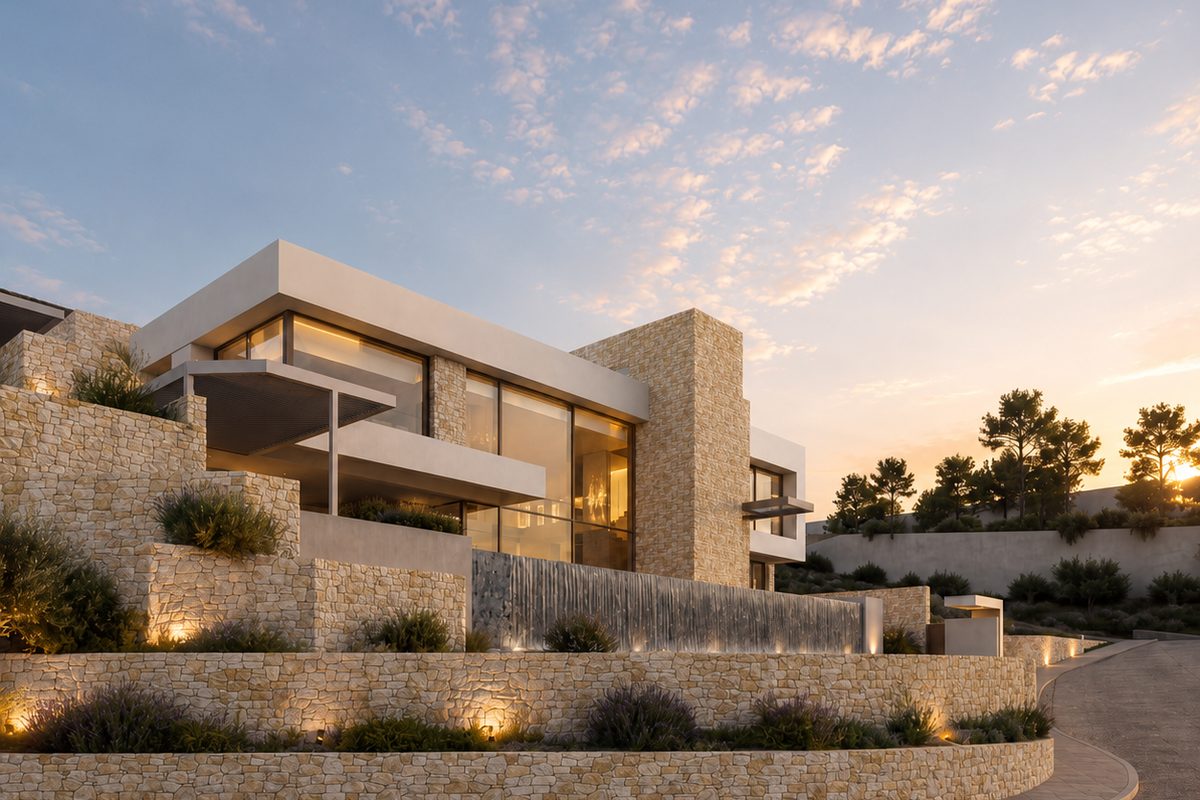
Building a house in Limassol in 2026 typically costs from €1,900 per square metre for the construction itself — €2,000–€2,500 for a standard home, €2,500–€3,000 for a high specification and €3,000 and up for a luxury villa — before land, professional fees and VAT. So a 200 m² home usually starts around €400,000 and rises well past €600,000 for a high-specification villa (C.F.L. working figures, 2026). Limassol sits at the top of the Cyprus range, and the reason is rarely the concrete. It is the land, the location, the queue for a good contractor, and the items that never appear in a per-square-metre headline.
This guide sets out what a Limassol build actually costs in 2026: the rate per m², what that rate leaves out, why the city costs more than Paphos or Larnaca, how VAT works on a first home, and how long the whole thing takes. The numbers below are current market ranges with their sources dated. Confirm the figure for your own plot before you commit, because Limassol has one of the widest price spreads on the island.
Construction cost in Cyprus is quoted per square metre of covered area, and it moves with the specification you choose rather than the postcode. The materials, the seismic code and the labour rates are broadly the same across the island. What changes the rate is the level of finish — and not only that: supply and demand in the construction market move it too. The realistic floor for a complete home, including essential external works, is around €1,900 per m²; very basic builds can dip below that, but a habitable, finished house rarely does.
| Build standard | Cost per m² (2026) | What it buys |
|---|---|---|
| Standard / mid-range | €2,000–€2,500 | Quality finishes, fitted kitchen and bathrooms, aluminium glazing |
| High specification | €2,500–€3,000 | Premium materials, larger glazing spans, upgraded MEP systems |
| Luxury villa | €3,000+ | Top-tier materials, large glazing spans, pool, smart-home and climate systems |
The axis starts at €1,800, not at zero: from zero these three bands render as near-identical bars and the differences between them — which are the whole decision — disappear. Only the luxury band is open-ended, and that is where a budget can keep travelling. Same figures and same source as the table above.
A useful way to read this: the rate tells you what the building costs. It does not tell you what the project costs. On a Limassol plot, the gap between those two numbers is often 20–30%, and it can be foreseen in advance — through a quantity survey of the construction, once the site has been surveyed.
The headline rate covers the house standing on flat, serviced ground. Very few Limassol plots are flat and serviced. The costs below are not exotic — they are simply the line items that do not fit inside a rate per m², and they are where budgets drift.
The per-square-metre rate prices the house. The plot prices the project. On a Limassol slope, the difference is the retaining wall, the deeper foundations and the longer service run — none of which show in a headline figure.
If you want these itemised before you buy the plot rather than after, that is the work our construction budget and feasibility service exists to do.
Limassol carries some of the highest property and land values in Cyprus, driven by its role as the island's international business centre and a limited supply of coastal land. That premium reaches the construction budget through four channels — and none of them is the price of a bag of cement.
Land. Limassol carries some of the highest residential values in Cyprus, and land follows. According to the RICS Cyprus Property Price Index (KPMG), Limassol consistently leads the island on price, and prime coastal and hillside plots command a large premium over other districts. Land is not construction cost, but it sets the total the bank and the buyer actually see, and it is the single biggest number separating a Limassol project from a Paphos one.
Contractor demand. Limassol runs a busy pipeline of high-rise and premium residential work, so good contractors are booked ahead. That shows up as a scheduling premium and less room to negotiate — the opposite of a quieter district where a builder is bidding to fill a gap.
Plot conditions. Much of Limassol's desirable residential land is sloped — Palodia, Agios Tychonas, the hillsides above the town. Slope means retaining structures, deeper or stepped foundations, and more complex access for machinery. A hillside minimalist villa we designed in Palodia is a fair illustration: the architecture is clean and simple, but the groundworks below it are not.
Coastal rules. Seafront and near-coast plots bring setback lines and additional restrictions. They can also bring the highest build specifications, because that is what the location is for.
VAT is the single largest cost most self-builders overlook, and Cyprus applies it in two bands. The reduced 5% rate is a genuine saving, but it is conditional and it is measured on buildable area, not on the covered area a brochure might quote. The full rules — thresholds, eligibility, how the rate is claimed — are set out in our VAT on property in Cyprus guide.
The practical trap in Limassol is the 190 m² ceiling. Buyers here often want more than 190 m² of buildable area, and crossing that line moves the whole build from 5% to 19% — not just the excess. The example villas in this guide make the point directly: a 200 m² or 250 m² home is already past the 190 m² ceiling, so it is a 19% build, not a 5% one. The reduced rate realistically fits a smaller primary residence, not a large villa — so decide where your design sits relative to that threshold at the start, because it is a budgeting decision as much as a design one.
The 5% rate is also not automatic. You, or your lawyer, submit a declaration to the Cyprus Tax Department through its Tax For All (TFA) system, confirming the home will be your primary and permanent residence for at least ten years. It can be filed during construction or before you take occupation, but it must be in before you move in — a step self-builders sometimes discover too late.
There is a related saving worth knowing. Where a sale is subject to VAT, at either rate, no property transfer fees are charged at all; a resale falls outside VAT and carries transfer fees on the statutory 50%-reduced scale instead (Department of Lands and Surveys Fees and Charges Law, CAP. 219, art. 10). A new, VAT-charged home therefore avoids a cost that a resale would carry, which partly offsets the VAT itself.
| VAT position | Rate | The conditions (2026) |
|---|---|---|
| Reduced rate — primary residence | 5% | Applies to the first 130 m² and the first €350,000 of value, for a permanent primary residence you use yourself |
| Standard rate above the threshold | 19% | Applies to area and value above 130 m² / €350,000 |
| Not eligible at all | 19% on the whole | If total buildable area exceeds 190 m² or total value exceeds €475,000 |
Buildable area and value
The same three positions as the table, drawn as the ladder they are: two thresholds, and a third step that removes the relief entirely rather than tapering it. Confirm your own eligibility with the Cyprus Tax Department — this is not tax advice.
Two clocks run on a Cyprus build: the permit clock and the construction clock. The permit side has moved faster since Cyprus piloted a fast-track route in October 2024.
Under the fast-track route, a Category A planning application that the authority does not reject within 20 working days is deemed granted and issued automatically through the Ippodamos system on the 21st day.
Applications run through the Ippodamos digital platform, launched in October 2023, and all planning applications have been submitted through it since 2024. The fast-track route also introduces designer self-monitoring and on-site checks by appointed building inspectors at three stages of construction, under regulations being finalised with ETEK. That shift makes competent, independent inspection more important, not less. Timelines still vary by municipality, so confirm the current position with the Department of Town Planning & Housing for your specific plot. Our guide to the building permit process in Cyprus sets out the steps in order.
The errors below are ordinary, not dramatic — which is exactly why they cost money.
It omits land, site works, fees and VAT, and on a sloped Limassol plot those can add a third to the total.
A slope, a rock line or a distant utility connection is far cheaper to discover before you commit than after.
Without seeing the 19%-on-everything consequence.
A design that does not fit the plot, the budget or the brief is paid for twice — once in the drawings and again on site.
Without a fixed scope, so variations rebuild the budget mid-project.
Survey, then design, then permit, then price. Reversing any two of those is where the money goes.
If you are still choosing a builder, our guide on how to choose a building contractor in Cyprus and an independent building inspection are the two cheapest forms of insurance available.
Building in Limassol in 2026 runs from roughly €1,900 per m² to construct, and past €3,000 for a luxury villa. What decides your actual budget is the total project cost, which the plot, the slope, the VAT band and the contractor market shape as much as the design does. Treat any rate per square metre as the beginning of the arithmetic.
Before you commit to a plot or a builder, it is worth having the drawings and the numbers checked together by one team. That is what our construction budget and feasibility work is for, and it is the same discipline behind every luxury villa we design in Cyprus. For the island-wide picture, see our cost of building a house in Cyprus guide.
What it costs to build a house in Cyprus in 2026 — the rate per m², a full worked budget from plot to keys, and where the number really moves.
The two permits you need to build in Cyprus, who issues them since the 2024 reform, how the fast-track works and how long each stage really takes.
A neighbourhood-by-neighbourhood read of where Limassol's luxury villa pricing actually sits this year — and why the top of the market has moved faster than the middle, while entry-level premium has barely moved at all.