


Aug 2026Read full article
Cost of Building a House in Cyprus, 2026
What it costs to build a house in Cyprus in 2026 — the rate per m², a full worked budget from plot to keys, and where the number really moves.
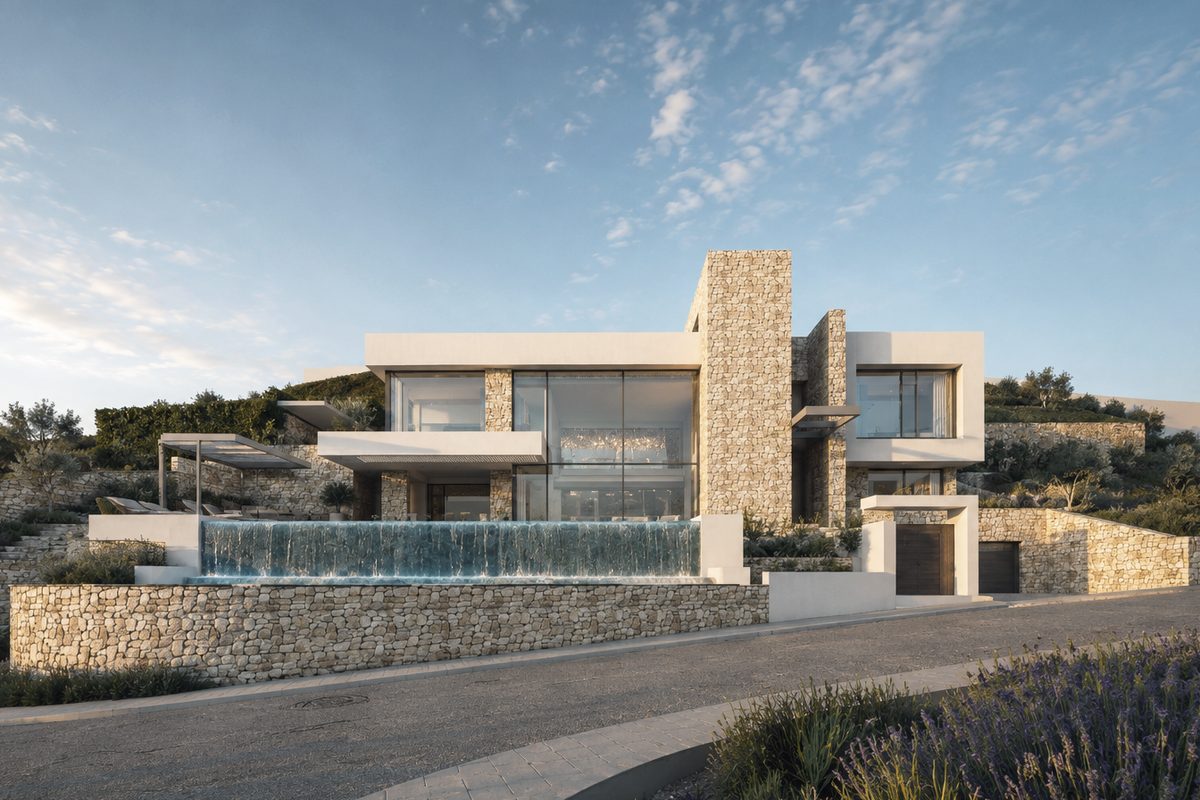
A Paphos build budget is settled on the plot, usually before the design has started. The cost of building a house in Paphos in 2026 runs from €1,900 per square metre to construct — €2,000–€2,500 for a standard home, up to €3,000 and beyond for high specification and luxury — before land, professional fees and VAT. That is the same core range as the rest of Cyprus, since materials and the building code do not change by district (C.F.L. working figures, 2026). Access, slope and the distance to the nearest mains connection are what separate one Paphos project from another.
Two questions decide most Paphos budgets. What will this particular plot cost to build on, and how much of the gap with Limassol is real. The guide answers both, then covers VAT on a first home and how long a Paphos build takes on site. Every figure below is a current market range with its source dated, and every one of them needs re-checking against your own plot.
Construction cost is quoted per square metre of covered area and moves with specification, not location. A mid-range home and a luxury villa sit at opposite ends of the same range whether the plot is in Kato Paphos or Tala. A finished, habitable house that includes essential external works starts realistically at around €1,900 per m²; anything cheaper usually means an unfinished shell or a corner cut.
| Build standard | Cost per m² (2026) | What it buys |
|---|---|---|
| Standard / mid-range | €2,000–€2,500 | Quality finishes, fitted kitchen and bathrooms, aluminium glazing |
| High specification | €2,500–€3,000 | Premium materials, larger glazing spans, upgraded MEP systems |
| Luxury villa | €3,000+ | Top-tier materials, large glazing spans, pool, climate and smart systems |
The axis starts at €1,800, not at zero: from zero these three bands render as near-identical bars and the differences between them — which are the whole decision — disappear. Only the luxury band is open-ended, and that is where a budget can keep travelling. Same figures and same source as the table above.
Don't read a sale price as a build cost — the gap between them is land, site works, fees and margin, and reading them as the same is the most common budgeting error we correct.
For context, a finished new home in Paphos is not the bargain it once was. By early 2026, average new-home prices in Paphos had risen above Limassol's — roughly €697,000 versus €582,000 (Cyprus Property News, February 2026), with villa averages in premium areas above €646,000. The point for a self-builder is a good one: the build costs about the same per m² as anywhere on the island, yet the finished result now holds strong value.
In Limassol, the budget pressure comes from land and contractor demand. In the Paphos district it more often comes from the ground and the location of the plot. These are the items that do not appear in a per-square-metre headline, and in Paphos they carry more weight than in the cities.
In Paphos, the cheap-looking plot is often the expensive project. A lower land price that arrives with a 300-metre service run and a retaining wall has moved the cost off the estate agent's page and onto your build budget, where it usually grows.
A modern family home we designed in Yeroskipou is a fair example of the district's economics: competitive land, a straightforward build, but the groundworks and connections deserved as much attention as the house. If you want those itemised before you buy, that is what our construction budget and feasibility service is for.
Roughly the same to build, cheaper on land — and no longer cheaper on the finished result. The construction rate per m² barely moves across Cyprus, so the build itself costs much the same in either city. Land in Paphos still tends to run below prime Limassol. But the old assumption that Paphos is simply the cheaper market no longer holds for houses and villas: by early 2026, average new-home prices in Paphos had overtaken Limassol, and Paphos took 28% of Cyprus's luxury sales in 2025, up from 18% the year before (Cyprus Property News and Leptos Estates, 2026).
| Cost driver | Paphos | Limassol |
|---|---|---|
| Build rate per m² | €1,900–€3,000+ | €1,900–€3,000+ |
| Land price | Typically lower than prime Limassol | Highest in Cyprus |
| Contractor demand | Steadier, more negotiating room | High, scheduling premium |
| Dominant hidden cost | Site works, utility connections, logistics | Sloped coastal land, land price |
| New-home resale, early 2026 | Average now above Limassol | Strong, but overtaken by Paphos on average |
| Typical buyer | International self-build, relocation | Investor, high-end residential |
The build rate is the same in both cities — the row where nothing leans. Everything that separates the two totals sits in the rows around it. The marked rows are where Paphos costs less; they are not a verdict, since the rows below them are preferences rather than prices. Resale figures: Cyprus Property News and Leptos Estates, 2026; the buyer and demand rows are C.F.L.'s observation, not survey data.
So the honest case for building in Paphos is not “it's cheaper.” It is: a similar build cost, cheaper land, and a finished home that now holds its value against Limassol. On the ground, a serviced, level Paphos plot still builds for less than a Limassol equivalent, while a remote, sloped, off-mains plot can quietly cost more once the connections and groundworks are in. For the Limassol side of this comparison, see our Limassol build-cost guide.
The VAT rules are national, so the thresholds apply in Paphos exactly as they do elsewhere — the full detail is in our VAT on property in Cyprus guide. They matter more here, though, because so many Paphos buyers are relocators building the permanent home the reduced rate was designed for. The rate is measured on buildable area, not the covered area a brochure quotes.
Two points specific to Paphos. First, residence is the deciding condition: the 5% rate is for a primary, permanent home you occupy yourself, so a holiday villa or a rental is charged at 19% from the first euro — budget for that from the start. Second, the rate is claimed, not granted automatically. You or your lawyer file a declaration with the Cyprus Tax Department through its Tax For All (TFA) system, undertaking to use the home as your primary residence for at least ten years; it can be submitted during construction or before you take possession, but not once you have moved in.
Size matters as much as use. The 250 m² villa in this guide's examples already exceeds the 190 m² buildable-area ceiling, so it is a 19%-on-the-whole build regardless of residence — the reduced 5% rate realistically fits a smaller primary home, not a large villa.
One saving offsets part of the VAT. Where a sale is subject to VAT, at either rate, no property transfer fees are charged at all; a resale falls outside VAT and carries them on the statutory 50%-reduced scale instead (Department of Lands and Surveys Fees and Charges Law, CAP. 219, art. 10). A new, VAT-charged home therefore avoids a cost that a resale would carry.
Permits and construction run on separate clocks, and the Paphos district has historically sat on the slower end for building permits in some areas, so build the timeline in with margin. The fast-track route Cyprus piloted in October 2024 has helped at the planning stage.
Applications go through the Ippodamos digital platform, launched in October 2023 and carrying all planning applications since 2024. The reformed system pairs fast-track approval with designer self-monitoring and on-site checks by appointed building inspectors at three construction stages, under regulations being finalised with ETEK. On a remote Paphos plot, where the site is far from the design team's office, that independent inspection layer earns its keep. Timelines vary by district, so confirm the current position for your plot with the Department of Town Planning & Housing. Our building permit guide walks through the steps in order.
The Paphos errors are their own set, driven by the district's rural and expat-self-build character.
A finished villa's price per m² is not its build cost per m² — the difference is land, site works, fees and margin, and in Paphos that gap is wide.
Before pricing the service run, the access road and the treatment unit.
Without a professional on the ground checking the work against the drawings.
A holiday home or rental is charged at 19% from the first euro.
On a Paphos plot the discipline is simple: cost the ground before you cost the house. For international clients building from a distance, our project management and site supervision puts an independent professional between you and the site, and an independent building inspection does the same for anyone buying a finished Paphos home.
Building in Paphos in 2026 runs the same rate as the rest of Cyprus — from €1,900 per m² to construct, past €3,000 for a luxury villa — but the total project cost is decided by the plot — its slope, its distance from the mains, and how far materials and trades have to travel. Lower land is a real Paphos advantage, and a remote plot with a long service run is a real Paphos cost. Both can hide behind the same headline rate.
In the Paphos district, the cheapest way to protect a budget is to have the plot, the drawings and the numbers assessed together before the offer goes in, while you can still walk away from the plot. That is the work behind our construction budget and feasibility service and every villa we design in Cyprus. For the island-wide overview, see our cost of building a house in Cyprus guide.
What it costs to build a house in Cyprus in 2026 — the rate per m², a full worked budget from plot to keys, and where the number really moves.
The two permits you need to build in Cyprus, who issues them since the 2024 reform, how the fast-track works and how long each stage really takes.
A neighbourhood-by-neighbourhood read of where Limassol's luxury villa pricing actually sits this year — and why the top of the market has moved faster than the middle, while entry-level premium has barely moved at all.